 FREE Birth Chart Calculator


Tarot Solitaire
Free online solitaire with a tarot readingLet Your Story Unfold
Classic Klondike with tarot artwork.
Win, and your Card of Fate awaits.
♥ Cups · ♦ Pentacles♠ Swords · ♣ WandsA → 2…10 → J → Q → K
Your browser isn’t saving this game. You can keep playing while this page stays open.
Start a new game? It will replace your current game.
Bonus Tarot Reading
What Will You Ask the Cards?
Choose a topic. Then three Major Arcana cards will appear for you to pick from.
Ask Yourself
What This Card Says About Other Topics
Tarot Solitaire is a reading for the persistent: you don’t get your prediction right away—you earn it with a win. It’s the Klondike you know, with the Minor Arcana in place of ordinary playing cards. As you sort Swords and Cups, Wands and Pentacles into their foundations, keep your question in mind. There’s no hurry: hints and undo are always within reach.
When the last King falls into place, your reward awaits: the Card of Fate. Choose a topic, then pick one of three face-down Major Arcana cards, and it will answer your question. Play free, with no sign-up, on your phone or computer.
How to Play Tarot Solitaire
Tarot Solitaire follows the same rules as Klondike: collect all four suits from Ace to King. The video shows the whole table and the key moves; the diagrams below it explain each idea on its own.
The Table at a Glance. This video takes just over a minute. First you’ll see the whole table, then the key moves. Pause whenever you like, or start at any step.
These diagrams stay still. The first labels the whole table; the next six explain one idea each.
- 1Stock. The remaining 24 cards sit here face down. Tap the stock to turn the top card face up beside it.
- 2Drawn Card. The card drawn from the stock lands here. You can move it to a column or a foundation.
- 3Foundations. Four spaces, one for each suit: Swords, Cups, Pentacles, and Wands. Build each pile in order from Ace to King.
- 4Columns. There are seven: one card in the first, two in the second, and so on up to seven. Only the top card is face up; the rest are face down.
Every step of the game, plus why the deck has no Knights and what the letters on the cards mean.
- The deal. There are seven columns on the table: one card in the first, two in the second, and so on up to seven. Only the top card of each column starts face up. The remaining 24 cards go in the stock.
- The stock. Tap it to turn the top card face up beside it. You can move that card to a column or a foundation. When the stock runs out, tap it again to go through the cards once more—as many times as you like.
- The columns. Build down in rank, alternating colors. You can move a whole sequence, too, as long as it’s in the right order.
- The foundations. Send cards to the foundations one at a time, in order. Until the game is complete, you can move a card from a foundation back to a column.
- The win. Once all 52 cards are in the foundations, your bonus reading opens. If all that’s left is to send the cards up, they’ll fly there on their own.
Why There Are No Knights in This Deck
A full tarot deck has 14 Minor Arcana cards in each suit, including a Knight. Klondike needs 52 cards, just like a regular playing deck, so we’ve removed the four Knights. That leaves the Ace, 2 through 10, and three court cards: the Page (marked J, taking the Jack’s place), the Queen (Q), and the King (K).
What the Card Markings Mean
The large markings at the top and bottom show each card’s rank and suit. A is Ace, followed by 2 through 10, J for Page, Q for Queen, and K for King. The suit’s color is what matters in play: black means Swords ♠ or Wands ♣; red means Cups ♥ or Pentacles ♦. Follow the suit symbol, not the colors in the artwork.
How to undo a move or get a hint, why a card won’t move, and how to scroll through the columns on your phone.
- Undo takes you back one move at a time, up to eighty moves.
- Hint highlights an available move. It doesn’t promise a win: what happens next depends on the deal.
- A card won’t move? Check that it’s one rank lower and the opposite color to the card you’re placing it on. A foundation only accepts the next card in order, in the same suit.
- Want a closer look at the artwork? Select a card and tap “View Card.”
- On your phone, the columns are large, so some sit beyond the edge of the screen. Swipe across the board to scroll. If a selected card has an available space off-screen, a blue arrow will appear at that edge with the number of places it can go.
How to Get Your Tarot Reading
Your Tarot Solitaire reading unfolds in two stages. First, play Klondike while thinking about what’s on your mind. When you win, the Major Arcana cards answer your question.
How to keep your question in mind, what to do if you don’t win, and how to choose a topic and one of the three cards.
- Choose a topic or question. Think about what matters most to you right now: a relationship, work, a choice, or tomorrow. You don’t need to say your question aloud; just hold it in your mind. If you want a yes-or-no answer, phrase your question so it can be answered that way.
- Take your time with the game. Play as you normally would: hints and undo won’t affect your reading. Solitaire helps you settle down and focus. If you don’t win, start a new game. That isn’t a “no” to your question; it’s simply a different deal.
- Complete all four foundations. Once the last card is in place, your bonus reading opens.
- Choose a topic and a card. There are seven topics: Love, Future, Advice, Career, Decisions, Tomorrow, and Yes or No. Then choose the one of three face-down cards that draws your eye. That’s your Major Arcana card.
- Read the whole answer. It has several parts: the card’s imagery and keywords, a headline with a clue and an interpretation for your topic, and a question to ask yourself. Read them together and notice what resonates. Below, you can see what the same card says about other topics.
In Yes or No, your card gives one of four answers. Each is gentle and leaves you room to act.
- Yes Circumstances are on your side. You can act without waiting for a special sign.
- Leaning yes The way is open, but there’s a condition. The interpretation names it, and much depends on whether you meet it.
- Too soon This isn’t a rejection. The answer is still taking shape, and rushing only gets in the way.
- Leaning no As things stand, this plan won’t work out. But the card shows another way forward and what you can change.
Which Ace appeared first, where a King got stuck, and what each of the four suits means.
If you’d like to find meaning in the game itself, watch how it unfolds. This is symbolism to explore for interest, not a prediction.
- Which Ace appeared first? Its suit sets the tone. Wands speak of action and desire; Cups, of feelings; Swords, of thoughts and conversations; Pentacles, of work, money, and everyday life.
- Which suit filled its foundation first? That’s the area of your life with the most movement right now.
- Where did a King get stuck? That area will take patience and time.
- Had to start over? A second deal often helps you see your question differently.
The Tarot Suits and What They Mean
♣WandsFire · black suitEnergy, action, desire, creativity, and bold beginnings.
♥CupsWater · red suitFeelings, relationships, intuition, and matters of the heart.
♠SwordsAir · black suitThoughts, words, decisions, truth, conflict, and resolution.
♦PentaclesEarth · red suitMoney, work, home, the body, and material stability.
The decisions are yours: the cards offer an image and something to think about. For a reading built around your own question, try Tarot: 1,000 Questions. For a little daily guidance, visit Card of the Day.
The 22 Major Arcana: Which Card Will You Draw?
Every Major Arcana card in the deck is part of the bonus reading. Each has its own imagery and meaning. Here’s a brief introduction to help you understand the answer you receive after a win.
Show All 22 Major Arcana Cards
-
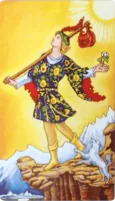 The Fool (Fool)
0 · new beginnings, trust, lightheartedness
The Fool is the card of the first step. A light bundle over one shoulder, bright sunshine, and the whole world ahead: everything is just beginning.
-
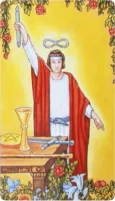 The Magician
I · willpower, mastery, action
All four elements are already on the table. The Magician shows you that the tools are there; all that's left is to decide what to make with them.
-
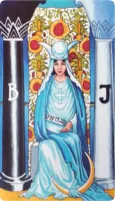 The High Priestess
II · intuition, mystery, stillness
This is the card of knowledge that needs no proof. It arrives when the answer is already within you, but needs quiet to be heard.
-
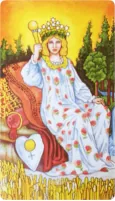 The Empress
III · abundance, care, growth
This card is the warmth of home, a table set for a meal, and the creative power that brings new things to life. It arrives when it's time to care for others and yourself alike.
-
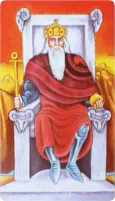 The Emperor
IV · order, support, responsibility
This card is about the order that keeps life afloat: boundaries, rules, responsibility, and the ability to stand behind your decisions.
-
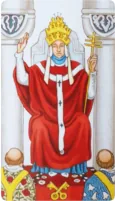 The Hierophant (The High Priest)
V · mentor, traditions, values
This card is about wisdom passed from person to person: teachers, mentors, family traditions, shared values.
-
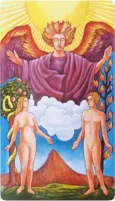 The Lovers
VI · choice, closeness, agreement
This card is about honest intimacy and choosing with your heart: seeing another person and yourself without masks, and trusting what you feel.
-
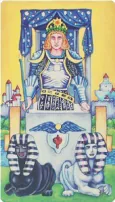 The Chariot
VII · victory, willpower, movement
The Chariot is the card of victory earned by someone who can keep opposing forces in hand: desire and caution, impulse and calculation.
-
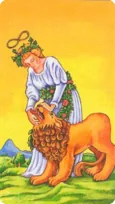 Strength
VIII · courage, gentleness, patience
Strength here lies in quiet confidence rather than force. It's the ability to handle your fears and impulses with gentleness.
-
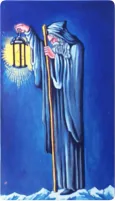 The Hermit
IX · solitude, wisdom, inner light
The Hermit is the card of time alone for your own sake, rather than retreat from other people. Quiet and an honest look within help you find what you can't find in the bustle.
-
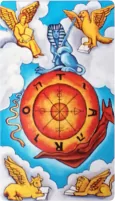 Wheel of Fortune
X · change, opportunity, cycles
This card is about the cycle of events: what is down will rise, and what is up will come down someday. The Wheel doesn't ask whether you're ready, but it always offers a chance.
-
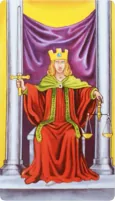 Justice
XI · truth, balance, responsibility
This card is about cause and effect: every action leaves its mark, and an honest look at a situation restores balance.
-
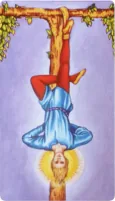 The Hanged Man
XII · pause, fresh perspective, acceptance
The Hanged Man marks a pause, when the familiar picture turns upside down. Time seems to stop so you can see what matters most.
-
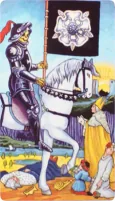 Death
XIII · endings, renewal, release
In Tarot, Death is almost never about dying. It marks the end of a chapter, a farewell to what has run its course, and the clearing of space for something new.
-
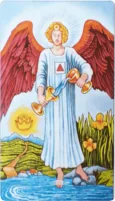 Temperance
XIV · balance, harmony, patience
Temperance is the art of blending different things into a harmonious whole. The sweet spot between extremes.
-
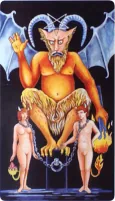 The Devil
XV · attachment, temptation, shadow
The Devil is the card of attachments, temptations, and habits that hold you more tightly than you realize. The shackles here are often unlocked: you only need to notice them and decide to take them off.
-
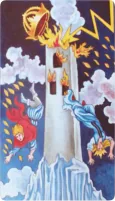 The Tower
XVI · revelation, change, release
The Tower is the card of sudden revelation. What was built on an illusion, or built too rigidly, comes crashing down, and you can build again on the cleared ground.
-
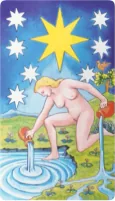 The Star
XVII · hope, healing, inspiration
The Star is the card of hope, healing, and quiet faith in better things. It arrives after the storm with a reminder: the light hasn't gone out; it was simply waiting to be seen.
-
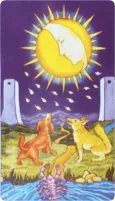 The Moon
XVIII · intuition, dreams, uncertainty
The Moon is the card of uncertainty, dreams, and subtle feelings. Nothing looks quite as it is, so don't rush to conclusions.
-
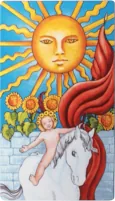 The Sun
XIX · joy, success, clarity
The Sun is the card of simple, real joy: clarity, warmth, confidence in yourself, and a world that supports you.
-
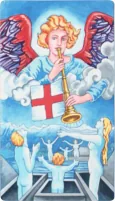 Judgment
XX · awakening, calling, forgiveness
Judgment is the card of awakening and taking stock. The past has been understood and forgiven, and you can answer the call that has long been sounding within you.
-
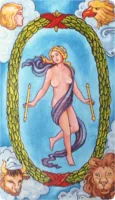 The World
XXI · completion, wholeness, success
The World is the card of completion and wholeness. A great cycle is complete, and it's time to feel that you're right where you belong.
Questions About the Game and Your Reading
Do I need to know tarot meanings to play?
No. In solitaire, it’s the card’s rank and suit color that matter. Your Major Arcana card’s meaning appears with your reading after you win, and you’ll find short descriptions of all the cards on this page.
How is Tarot Solitaire different from Klondike?
Tarot Solitaire keeps the rules of Klondike. The differences are the deck and the reward: you play with 52 Minor Arcana cards, with the four Knights removed, and a win opens a bonus Major Arcana reading.
Why are there no Knights in the deck?
A full tarot deck has 56 Minor Arcana cards, 14 in each suit, including Knights. Klondike needs a 52-card deck, so the four Knights are removed. Pages take the Jacks’ place; Queens stay Queens, and Kings stay Kings.
Why won’t my card move?
Check that it’s one rank lower than the destination card and the opposite color. Only a King can go in an empty column, and a foundation only accepts the next card in order, in the same suit. Face-down cards can’t move: you need to uncover them first.
What does it mean if I don’t win?
Only that you haven’t managed to finish this game yet. It isn’t a “no” to your question or a bad sign. Undo a move, try a different sequence, or start a new deal.
Will my game be saved if I close the page?
Yes. Your game is saved in your browser, so you can pick up where you left off when you return. On another device or in another browser, you’ll start a new game.
Do I have to pay for the reading after I win?
No. The game and the bonus reading are completely free, with no sign-up needed. To reveal your prediction, complete all four foundations.
Can I get more than one reading?
Yes. Every new win opens a new reading with different cards. You can also ask the card you’ve drawn about other topics: the buttons below your interpretation cover the other six.
How do I play on my phone?
Tap a card, then tap where you want it to go. Double-tap a card to let it find an available space on its own. If the column you need is off-screen, swipe across the board or tap the blue arrow that appears when you select the card.
How is this different from Indian Solitaire?
In Indian Solitaire, you rotate cards to match pieces of pictures. Here, you move cards by the rules of Klondike and receive your prediction after a win.
More Readings to Try
Golden
Fish
A yes-or-no oracleFish
for your wishes
Ask the Fish >>
Indian Solitaire
Turn 25 cards until two halves make one picture.Get Your Free Reading >
Magic 8 Ball Online
Ask a yes-or-no question. Get one of the 20 classic answers.Ask the Magic 8 Ball >
Daily Tarot Reading
FREE Fortune telling for today, tomorrow1 Tarot card
Get Your Free Reading >

Free Readings

All Divinations

Fortune Telling

Tarot Readings 1000 Qs

Tarot Master

Free Love Tarot

Coffee Reading

Fortune Cookies

Ask the Universe

Tarot Solitaire

Golden Fish
Magic 8 Ball

Three Rune Reading

Dice Divination

Indian Solitaire

Free Runes Reading

I-Ching

Love Compatibility
Daily Tarot Reading

Daily Rune

Yes/No Rune Reading
Celtic Cross Free

Daisy Love Oracle

Octopus Predictor
Yes/No on a Coin

Wish Tree

Heads or Tails?
Yes/No Tarot

Lucky Cat
Tarot Card Meanings

All Tarot Cards
The Fool

The Magician

The High Priestess
The Empress

The Emperor

The Hierophant

The Lovers
The Chariot

Strength

The Hermit

Wheel of Fortune

Justice
The Hanged Man

Death
Temperance

The Devil
The Tower

The Star

The Moon

The Sun

Judgment

The World

Ace of Swords

Two of Swords

Three of Swords

Four of Swords
Five of Swords
Six of Swords
Seven of Swords
Eight of Swords
Nine of Swords
Ten of Swords

Page of Swords

Knight of Swords

Queen of Swords

King of Swords

Ace of Cups

Two of Cups
Three of Cups
Four of Cups

Five of Cups
Six of Cups
Seven of Cups
Eight of Cups
Nine of Cups
Ten of Cups

Page of Cups

Knight of Cups

Queen of Cups

King of Cups

Ace of Pentacles

Two of Pentacles

Three of Pentacles

Four of Pentacles
Five of Pentacles

Six of Pentacles

Seven of Pentacles

Eight of Pentacles
Nine of Pentacles
Ten of Pentacles

Page of Pentacles

Knight of Pentacles

Queen of Pentacles

King of Pentacles

Ace of Wands
Two of Wands

Three of Wands

Four of Wands

Five of Wands
Six of Wands

Seven of Wands
Eight of Wands

Nine of Wands
Ten of Wands

Page of Wands

Knight of Wands

Queen of Wands

King of Wands
more cards
close
Daily Horoscope

Daily Horoscope: Today

Daily Horoscope: Tomorrow
Daily Love Horoscope

Weekly Horoscope
2027 Yearly Horoscope
2026 Yearly Horoscope
Zodiac Signs Traits

All Zodiac Signs

Aries Traits

Taurus Traits

Gemini Traits

Cancer Traits

Leo Traits

Virgo Traits

Libra Traits

Scorpio Traits

Sagittarius Traits

Capricorn Traits

Aquarius Traits

Pisces Traits
more signs
close
Divinate for Today