
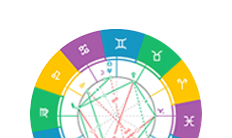
 FREE Birth Chart Calculator


A square is an angle of 90 degrees. It's that very tension everyone fears and without which couples usually fall apart from boredom.
How square feels in a couple
A square feels like friction. Not dislike, but precisely a mismatch of methods: you both want the same thing, but you go at it in such different ways that you get in each other's way. You can't miss a square: it pokes out in the most ordinary situations and demands that you do something about it.
Where square goes in the calculation
The reading has five separate scales, and the same angle feeds into them differently. Here's the weight with which square goes into each one; these are literally the coefficients the results page is calculated by. Scales that aren't on the list don't get this angle at all.
Where square rings loudest
An angle by itself says nothing; what matters is which planets it fell between. Here are the combinations in which this angle changes the most in a couple. Each has its own page with a full reading in both directions.
What to do about it
You don't smooth squares out, you distribute them. In every such connection there are two functions, and almost always one of you is better at one of them. Agreeing on who leads in that area is a working solution. Trying to remake the other person to suit yourself is not.
A common misconception
“A square is a bad aspect, you can't live with it.” Long couples usually have no fewer squares than trines. The difference isn't whether there's a square but whether the two of them have learned to handle it. A couple with no squares at all more often breaks up not in a quarrel but because things got boring.
What to look at next
Calculate your synastry
1 personBirth chart
2 peopleCompatibility by date of birthSynastry of two birth charts

Marta Winter, astrologer. Synastry interpretations and guidance for reading the relationship between two birth charts.
How this is calculated. Planet positions are calculated in UTC ephemeris data (Moira 6.1.0 / NASA JPL DE440), with Swiss Ephemeris for houses and boundary dates. The rarity of the shared astrological pattern is compared against a sample of 250,000 couples. More about our method →